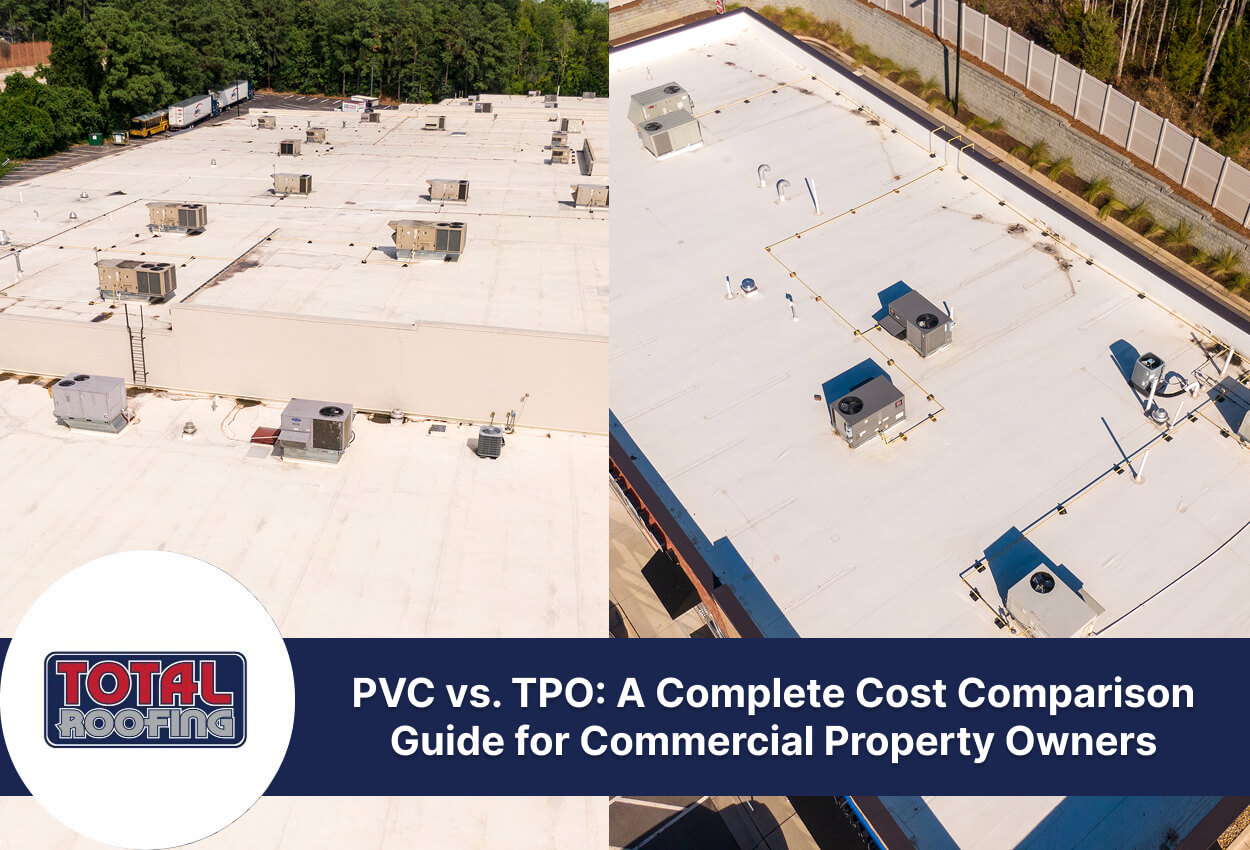




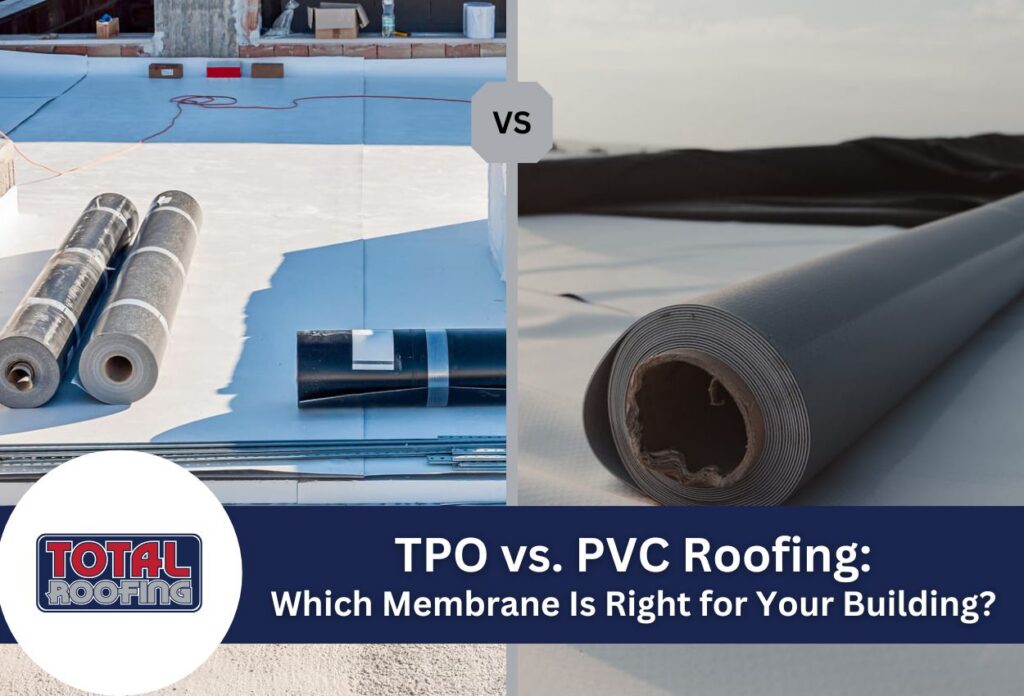

TPO typically costs $6 to $10 per square foot installed, while PVC runs $7 to $14 per square foot, making TPO the more budget-friendly single-ply option, while PVC delivers superior chemical resistance where grease or exhaust exposure is a concern. Both are heat-welded single-ply membranes used on flat and low-slope roofs, and both are widely installed across the St. Louis metro.
St. Louis puts flat roofs through a lot. Wide temperature swings between seasons, intense summer UV stress, seasonal hail risk, and heavy spring rains all stress roofing membranes year after year. Older commercial and multifamily buildings throughout the city, many with flat or low-slope roofs built decades ago, regularly need single-ply membrane replacement as original systems age out.
*Please note, price ranges listed in this article may not reflect the final cost of your project. Prices are subject to change based on various factors such as local labor rates, material quality, and more. All costs established in this article are rough estimates based on average industry rates.
How Do TPO and PVC Roofing Membranes Actually Compare on Performance?
PVC edges out TPO on tensile strength and chemical resistance, but both membranes perform closely across most other measurable categories; the differences matter most depending on what your roof faces daily.
| Performance Category | TPO | PVC |
|---|---|---|
| Typical Membrane Thickness | 40 to 80 mil | 40 to 80 mil |
| Solar Reflectance | 0.79 to 0.83 | 0.80 to 0.85 |
| Tensile Strength | 17 to 22 lbf/in | 20 to 25 lbf/in |
| Low-Temperature Flexibility | Flexible to approx. -40 degrees Fahrenheit | Flexible to approx. -40 degrees: plasticizer migration is a long-term concern |
| Chemical and Grease Resistance | Moderate | High |
St. Louis winters regularly drop into the low 30s, while summers regularly reach the upper 80s to low 90s, a temperature swing that causes membranes to expand and contract season after season. Both TPO and PVC handle that range well when properly installed, but heat-welded seams on both membranes outperform adhesive-bonded seams under that kind of thermal cycling. PVC’s one long-term vulnerability is plasticizer migration, which gradually reduces flexibility as the membrane ages. On St. Louis buildings where roofs have been in place 15 to 20+ years, that stiffening can lead to cracking at seams and flashings, something worth checking before any reroof decision.
What Is the Real Cost Difference Between TPO and PVC Roofing?
TPO runs $6 to $10 per square foot installed, while PVC runs $7 to $14 per square foot, a gap that adds up fast on larger commercial roofs across the St. Louis metro.
| Building Size | TPO Installed Cost | PVC Installed Cost |
|---|---|---|
| 5,000 sq ft | $25,000 to $40,000 | $30,000 to $50,000 |
| 15,000 sq ft | $75,000 to $120,000 | $90,000 to $150,000 |
| 30,000 sq ft | $150,000 to $240,000 | $180,000 to $300,000 |
Three factors drive most of the cost difference between the two membranes. First, PVC membrane material costs approximately $0.50 to $1.50 per square foot more than TPO at the same thickness. Second, labor costs are comparable for both both use hot-air welding, so installation crews work at roughly the same pace. Third, the attachment method matters: a fully adhered system adds $0.75 to $1.25 per square foot over a mechanically attached system for either membrane, so building owners comparing bids should confirm which method each quote reflects.
St. Louis permit fees for commercial roof replacement vary by jurisdiction but typically range from $200 to $800 or more, depending on project valuation. Both TPO and PVC installations on commercial buildings will generally trigger a permit review under the local building department. Factor permit fees into your total budget from the start; they are easy to overlook and can add several hundred dollars to any commercial roof replacement project.
Which Membrane Lasts Longer: TPO or PVC Roofing?
PVC membranes typically last 20 to 30 years, with some documented installations exceeding 30 years, compared to 15 to 25 years for TPO membranes with proper maintenance. That gap reflects real-world history: PVC has been installed on commercial roofs since the 1960s, while TPO only saw widespread commercial adoption in the early 1990s. PVC simply has more decades of field performance data behind it.
Warranty terms for both materials follow similar structures. TPO warranties commonly range from 10 to 20 years, with no-dollar-limit (NDL) coverage available on select systems. PVC warranties also range from 10 to 20 years, including 15- and 20-year NDL options from major manufacturers. Both require a minimum membrane thickness, typically 60 mil or 80 mil for longer-term coverage and certified installer installation to keep the warranty valid. A 45 mil membrane may cost less upfront, but it will not qualify for the same warranty terms as a heavier system.
Membrane thickness is especially worth thinking through for St. Louis buildings. Hailstorms occur regularly across the metro, and puncture from hail impact is one of the most common causes of premature membrane failure. 60 mil and 80 mil membranes of either type provide meaningfully better puncture and hail resistance than 45 mil, making thickness selection one of the most important longevity decisions for any St. Louis flat roof replacement. Spending more on a thicker membrane up front can reduce repair calls and extend the time before the next full replacement is needed.
TPO or PVC: Which Membrane Should You Choose for Your Specific Building?
Your building’s rooftop exposures alone should drive the membrane decision. Chemical or grease exposure points to PVC every time: clean commercial roofs without those exposures are strong candidates for TPO. The table below matches common St. Louis building types to the membrane that fits best.
| Building Type | Recommended Membrane | Primary Reason |
|---|---|---|
| Restaurant or food service | PVC | Resists grease and chemical fumes from exhaust systems |
| Light industrial or manufacturing | PVC | Handles chemical exposure that degrades TPO over time |
| Standard commercial office or retail | TPO | Cost-effective and reflective with no chemical exposure risk |
| Multifamily flat-roof residential | TPO | Lower costs with adequate durability for typical exposure |
| Buildings near HVAC exhaust or rooftop grease vents | PVC | Resists plasticizer-attacking chemicals from exhaust sources |
- Grease or chemical exposure present on the roof: Choose PVC. Even moderate exposure degrades TPO faster than most owners expect.
- Budget is the main constraint, and no chemical exposure exists: TPO saves $1 to $2 per square foot or more compared to PVC at equivalent thickness.
- High-wind or hail-prone location in the St. Louis metro: Specify 60 mil minimum thickness for either membrane; thinner membranes carry higher puncture risk during severe weather.
- Existing roof uses a PVC membrane: Re-roofing with PVC over existing PVC is often compatible; mixing membranes requires a compatibility review before installation begins.
St. Louis’s older brick masonry and warehouse buildings, common throughout the urban core and inner-ring suburbs, often have irregular roof decks and gaps that make fully adhered systems the better choice, since full adhesion conforms more closely to uneven surfaces and improves wind uplift resistance compared to mechanically attached systems. Total Roofing can assess your building’s deck condition and exposure profile to confirm which membrane and attachment method makes sense before any work begins.
Does Choosing the Right Membrane Save You Money Over Time?
Yes, and the annualized cost math makes the case clearly. A PVC membrane on a 10,000 sq ft building might cost $80,000 installed versus $65,000 for TPO. That looks like a $15,000 premium upfront. But divide each cost across its realistic service life in a chemically exposed environment: $80,000 PVC over 25 years equals $3,200 per year, while $65,000 TPO over 17 years equals $3,824 per year. The cheaper membrane can actually cost more annually once replacement cycles are factored in.
Energy savings add another layer to the ROI picture. Both white TPO and white PVC membranes with solar reflectance above 0.65 may qualify for ENERGY STAR certification. CRRC-rated white membranes are commonly cited at 10% to 30% cooling energy reduction on affected roof areas, a real benefit on flat commercial roofs that absorb summer heat. That cooling need reduction lowers HVAC operating costs every season the membrane is in place.
Deferred maintenance is the single biggest cost multiplier on either system. A minor seam or flashing repair typically runs $300 to $800 per repair. That is a manageable cost. Skipping it until water gets into the deck or insulation is not deck, and insulation replacement costs run $3 to $8 per square foot or more, turning a small repair into a large project. Annual or biannual inspections catch those small failures early, before they grow into something far more expensive. Commercial roof maintenance programs are designed to catch exactly these issues before they escalate.
Ready to Choose Between TPO and PVC Roofing for Your St. Louis Building?
Getting a side-by-side quote for both membranes before committing to either is the fastest way to determine whether the $1-$ 2-per-square-foot cost gap between TPO and PVC makes sense for your specific building and budget. Total Roofing installs both TPO and PVC membranes across the St. Louis metro and can assess your roof’s exposures, deck condition, and size to give you a direct comparison in one visit. Spring and fall are the best scheduling windows for flat roof replacement in St. Louis, so booking early gives you the most flexibility.
Request a free roofing estimate.
Not ready to schedule? Learn more about our commercial roofing options.