



Everything You Need to Know About Commercial Roofing Services in St. Louis, MO
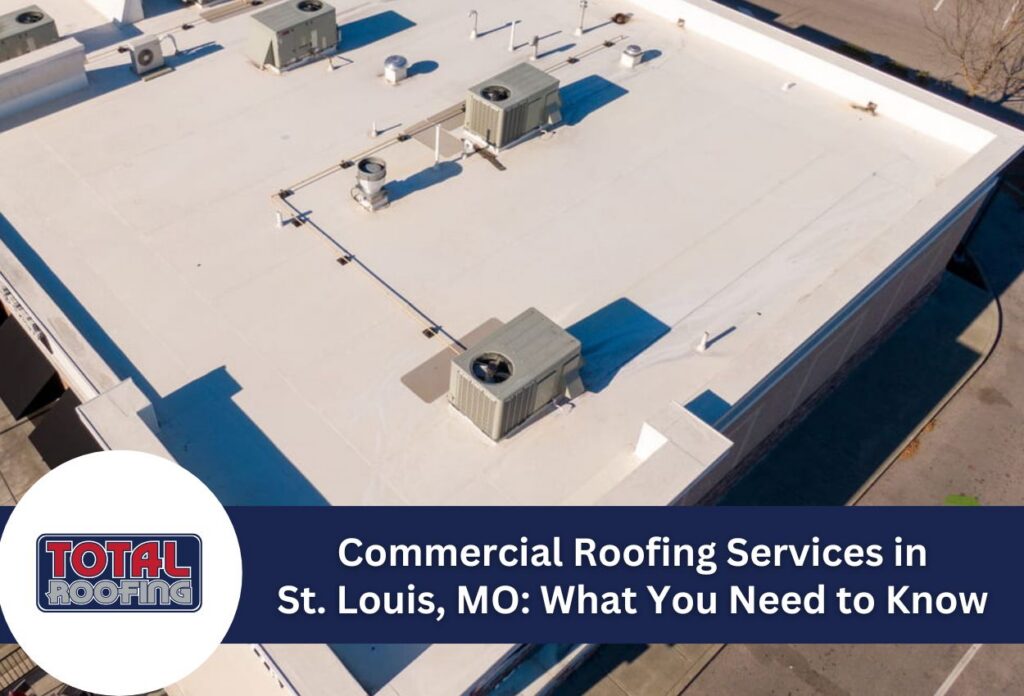

St. Louis commercial roofs face some of the harshest conditions in the Midwest — winter temperatures that drop to 15°F, summers that push 90°F, and roughly 42 inches of rain per year — making roofing decisions here higher-stakes than in more temperate markets. That 75-degree swing between seasons puts constant stress on membranes, seams, and flashing. Add in frequent hail, strong winds, and high humidity averaging 65% to 75%, and the margin for error on a commercial roof gets very small, very fast.
Commercial roofing services cover a wide range of work: inspections, repairs, full replacements, new installations, and ongoing preventative maintenance. In St. Louis, that work takes on added complexity. The city’s older brick and masonry buildings — many built between 1900 and 1970 — were designed with flat or low-slope roofs. Those designs collect water, stress membranes at transitions, and demand contractor knowledge that goes well beyond what standard residential roofing requires.
This article covers everything a St. Louis property owner needs to make a smart decision. You will learn which roofing systems perform best in this climate, what factors drive costs, how to evaluate and choose a qualified commercial roofing contractor in St. Louis, MO, when to schedule work, and how to move from research to action with confidence.
What Makes Commercial Roofing in St. Louis Different From Other Markets?
St. Louis sits in a climate zone that combines high humidity averaging 65% to 75%, summer heat reaching 90°F, and winter lows dropping to 15°F — a combination that pushes commercial roofing membranes harder than conditions in drier or milder markets. That temperature swing of roughly 75 degrees forces membranes to expand and contract daily during summer months. Over time, that repeated movement weakens seams and opens gaps at transitions. UV radiation compounds the problem by breaking down membrane materials on flat and low-slope roofs that have no pitch to redirect sunlight.
Winter brings a different set of problems. When heat escapes through a poorly insulated roof, it warms the membrane surface just enough to melt snow at the center. That water runs toward the edges, refreezes, and builds into ice dams. Those ice dams trap moisture against the membrane and flashing — exactly where leaks start. February in St. Louis is especially hard on commercial roofs because temperatures swing unpredictably, triggering repeated melt-and-refreeze cycles in a single week.
Older Buildings, Specific Vulnerabilities
Most commercial buildings in St. Louis were constructed between 1900 and 1970 using brick and masonry with flat or low-slope roof designs. Those roofs were built for a different era of materials and maintenance standards. Low spots collect ponding water — water that sits for 48 hours or more after rain and slowly degrades membrane integrity. Membranes also experience tension stress at transitions where rooftop HVAC units, curbs, and penetrations interrupt the flat surface.
Multiple roof levels, internal drains and scuppers that clog with debris, and high-traffic access paths for rooftop equipment all compound standard wear — making St. Louis commercial roofs measurably more maintenance-intensive than structures in drier, milder climates. Hail and high winds during severe storm seasons add puncture damage and flying debris risk on top of that baseline wear. Property owners dealing with these compounding factors will find more detail in a closer look at the most common commercial roof problems specific to the St. Louis market.
What Types of Commercial Roofing Systems Are Used in St. Louis, MO?
Five systems cover the vast majority of commercial roofs in St. Louis: TPO, EPDM, modified bitumen, built-up roofing (BUR), and metal roofing — and each performs differently under the city’s 75-degree seasonal temperature swing, high humidity, and frequent severe weather. TPO is a single-ply white membrane that reflects sunlight and welds at seams. EPDM is a rubber membrane known for flexibility during temperature changes. Modified bitumen is an asphalt-based sheet system well suited to retrofitting older flat roofs. BUR is a multi-layer built-up system using alternating felt and hot asphalt. Metal roofing uses standing-seam or structural panels and handles both heat and impact damage well.
| System Type | Best For | Climate Performance in St. Louis | Typical Lifespan | Relative Cost Tier |
|---|---|---|---|---|
| TPO | New installations, energy-efficient retrofits | Reflects UV heat in summers up to 90°F; weldable seams resist moisture in 65% to 75% humidity | 20 to 30 years | Low to mid |
| EPDM | Low-slope roofs, budget-conscious replacements | Stays flexible during temperature changes from 15°F to 90°F; absorbs heat in summer | 20 to 25 years | Low to mid |
| Modified Bitumen | Older flat-roof retrofits, high-traffic roofs | Handles temperature changes well; torch down application bonds tightly to aged decks | 15 to 20 years | Mid |
| Built-Up Roofing (BUR) | Multi-layer protection on historic buildings | Multiple layers resist ponding on flat roofs common in buildings built between 1900 and 1970 | 20 to 30 years | Mid to high |
| Metal Roofing | Long-term investment, hail-prone properties | Sheds ice and snow; withstands high winds and impact damage from frequent severe storms | 40 to 60 years | High |
TPO roofing installation in St. Louis, Missouri is the fastest-growing system choice among commercial property owners right now. Its white reflective surface reduces heat absorption during summers that push 90°F, and its heat-welded seams form a continuous bond that resists moisture infiltration — a direct answer to the city’s humidity levels averaging 65% to 75%. Property owners comparing TPO against EPDM will find the biggest differences in long-term energy savings and seam performance under St. Louis humidity conditions. A dedicated comparison of TPO versus EPDM roofing for St. Louis commercial buildings covers those differences in detail.
What Commercial Roofing Services Do St. Louis Contractors Typically Offer?
Most commercial roofing contractors in St. Louis offer eight core service categories — and knowing which one applies to your building is the difference between a repair bill and a full replacement cost.
- New roof installation: Covers ground-up construction on new commercial buildings or additions. Contractors select a system — TPO, EPDM, metal, or other — based on building design, load requirements, and St. Louis climate demands.
- Full roof replacement: The right choice when a roof has less than 20% serviceable life remaining, shows widespread membrane failure, or has accumulated multiple layers that no longer meet building code. Older brick buildings built between 1900 and 1970 often reach this point after decades of deferred maintenance.
- Roof repair and patching: Targets isolated damage — failed seams, punctures from rooftop foot traffic, or flashing separations at HVAC curbs. Repair makes sense when the surrounding membrane is structurally sound and the roof has serviceable life remaining.
- Flat roof repair services: Addresses the ponding water damage common in St. Louis’s older flat-roof commercial buildings. Standing water that sits more than 48 hours accelerates membrane breakdown and is a frequent problem on 1950s-era brick structures with internal drains that clog with debris.
- Preventative maintenance programs: Typically scheduled twice per year — once in spring after freeze-thaw temperature changes and once in fall before winter sets in. Catching small failures early can extend a roof’s serviceable life by 5 to 10 years.
- Emergency storm damage response: Activated after severe hail, high winds, or violent storms that are common in St. Louis spring and summer seasons. Fast response within 24 to 48 hours reduces interior water damage and supports insurance claims.
- Roof coating and restoration: A cost-effective option for roofs with solid decking and membrane structure still intact. Coatings applied over existing TPO or modified bitumen systems can extend service life by 10 to 15 years at a fraction of full replacement costs.
- Inspection and assessment services: A stand-alone evaluation that documents membrane condition, drainage performance, and flashing integrity. Most contractors recommend inspections at least once per year for St. Louis commercial properties because of the climate stress the region puts on roofing systems.
The dividing line between repair and replacement almost always comes down to how much serviceable life remains — roofs with isolated damage and sound decking are candidates for repair or restoration, while roofs with widespread membrane failure, recurring leaks, or significant ponding damage typically warrant full replacement. Each of these service categories — especially flat roof repair services in St. Louis, Missouri — supports its own detailed conversation worth covering in depth.
How Much Does Commercial Roofing Cost in St. Louis, MO?
Commercial roof replacement in St. Louis runs $5 to $15+ per square foot depending on the system type, roof size, existing deck conditions, and how complex the access is — and that range shifts fast once St. Louis-specific factors enter the picture.
| Service Type | Typical Cost Range | Key Cost Drivers | Notes for St. Louis Properties |
|---|---|---|---|
| New TPO Installation | $7 to $12 per sq ft | Roof size, insulation thickness, seam complexity | Reflective surface offsets summer cooling costs on roofs exposed to 90°F heat |
| EPDM Replacement | $5 to $10 per sq ft | Tear-off labor, adhesive method, deck condition | Dark membrane absorbs heat; best suited for buildings prioritizing budget over energy savings |
| Modified Bitumen Overlay | $4 to $8 per sq ft | Number of layers, torch down vs. self-adhered method | Common retrofit for brick buildings built between 1900 and 1970 with aged flat-roof decks |
| Flat Roof Repair — Minor | $300 to $1,500 flat fee | Patch size, seam vs. puncture, flashing condition | Best option when surrounding membrane has serviceable life remaining |
| Flat Roof Repair — Major | $1,500 to $6,000 flat fee | Ponding damage extent, deck rot, multiple failure points | Ponding water sitting 48+ hours accelerates deck deterioration on older St. Louis buildings |
| Roof Coating and Restoration | $2 to $5 per sq ft | Existing membrane condition, coating system selected | Extends serviceable life by 10 to 15 years when decking remains structurally sound |
| Emergency Repair | $500 to $3,000+ flat fee | After-hours labor, storm damage scope, access difficulty | Winter emergency calls command premium pricing due to ice, cold, and safety constraints |
Several St. Louis-specific conditions push projects toward the higher end of these ranges. Older brick and masonry substrates often require additional deck preparation before any new membrane can go down. Buildings with multiple roof levels add labor time and equipment costs. Missouri and St. Louis building codes require climate-appropriate sealants rated for temperature extremes — those materials cost more than standard alternatives. Winter emergency work carries the highest labor premium of all, since crews work under dangerous cold and ice conditions with limited installation windows.
Roof coating and restoration at $2 to $5 per sq ft can defer a full replacement — which runs $5 to $15+ per sq ft — by 10 to 15 years, making it the highest-value option for buildings with sound decking but aging membrane surfaces. That gap in costs is why many St. Louis property owners choose restoration over replacement when the structure supports it. Total Roofing can assess whether your roof qualifies for a roof coating and restoration approach or requires full replacement based on current deck and membrane conditions.
Repair vs. Replace: How Do You Know Which Option Is Right for Your St. Louis Commercial Roof?
Choosing between repair and replacement is the most consequential decision in commercial roofing — and getting it wrong in either direction wastes significant capital, whether that means patching a roof that needed full replacement years ago or tearing off a membrane that had serviceable life remaining.
Signs That Point Toward Repair
- Roof age under 15 years: A roof still in the first half of its expected lifespan is almost always a repair candidate, provided damage is contained and the surrounding membrane is performing.
- Damage covers less than 25% of total surface area: Isolated failures — a failed seam, a puncture near an HVAC curb, a flashing separation — can be corrected without replacing the full system.
- Membrane is structurally sound: No widespread delamination, bubbling, or separation across the field of the roof means the base system is still doing its job.
- No active interior leaks in multiple locations: A single leak traced to a specific failure point is a repair problem. Leaks appearing in three or more separate interior locations signal systemic failure.
Signs That Point Toward Replacement
- Roof has exceeded its expected lifespan: Once a system passes its serviceable life — 20 to 30 years for built-up roofing, for example — continued repairs become diminishing returns on investment.
- More than 30% of the membrane shows deterioration or moisture infiltration: At that scale, repair costs compound quickly and rarely solve the underlying problem.
- Ponding water that drainage improvements cannot fix: If standing water sitting longer than 48 hours is caused by structural deck deflection rather than clogged drains, drainage upgrades alone will not resolve it.
- Energy costs have risen due to insulation failure: Saturated or compressed insulation loses R-value and drives up heating and cooling costs — a replacement trigger that shows up on utility bills before it shows up on the roof surface.
- Repair costs exceed 30% to 40% of full replacement cost: Once a repair estimate crosses that threshold, replacement almost always delivers better long-term value per dollar spent.
St. Louis properties built before 1970 with original or once-replaced roofs deserve one additional step before any repair investment is committed. A professional core cut assessment — where a small sample is removed to evaluate insulation condition and deck integrity below the surface — is standard practice among the best commercial roofing companies in St. Louis. Skipping a core cut assessment on a pre-1970 building risks committing repair dollars to a deck that cannot support the investment. Total Roofing performs these assessments to give property owners a clear, evidence-based answer before any work begins.
What Roofing Materials Work Best for St. Louis’s Climate Conditions?
Reflective TPO membrane, tapered insulation systems, and ice and water shield underlayment rank as the top material choices for St. Louis commercial roofs because they directly address the full annual stress cycle — 90°F summer heat, year-round humidity averaging 65% to 75%, winter ice dam formation, and recurring hail and storm debris impact. No single material solves every problem, so the strongest commercial roofing systems in St. Louis combine materials that each handle a different threat. Skipping tapered insulation on a flat roof is the single most common reason ponding water — water that sits longer than 48 hours — causes premature membrane failure on St. Louis commercial buildings.
| Material / Product | Primary Function | Why It Suits St. Louis Conditions |
|---|---|---|
| Reflective TPO membrane | Heat reduction and waterproofing | Reflects summer UV load during 90°F heat peaks; reduces cooling costs on exposed flat roofs |
| Tapered insulation systems | Positive drainage correction | Eliminates ponding on flat and low-slope roofs where deck deflection traps standing water |
| Ice and water shield membranes | Edge and penetration protection | Seals roof edges and vulnerable flashings against ice dams that form and refreeze in St. Louis winters |
| High-quality climate-appropriate sealants | Joint and penetration sealing | Missouri building codes require sealants rated for temperature extremes — standard products fail under the full swing from 15°F to 90°F |
| Walkway pads | Puncture prevention | Protects membranes on roofs with HVAC equipment requiring regular maintenance foot traffic |
Reflective TPO membranes reduce cooling loads during St. Louis summers, where temperatures regularly reach 90°F and high humidity compounds the heat stress on a building’s interior. Tapered insulation is a particularly important investment for flat-roof properties — the building type most common among St. Louis brick and masonry structures built between 1900 and 1970 — because those roofs rarely drain adequately without slope correction built into the insulation layer. A flat roof without proper drainage is not just a water problem; it is an accelerated membrane failure problem that turns a restoration candidate into a full replacement job.
When Is the Best Time of Year to Schedule Commercial Roofing Work in St. Louis?
Spring, from March through May, is the best window for planned commercial roof replacements and large installations in St. Louis — temperatures stabilize, materials adhere properly, and contractors can work without the cold-weather constraints that compromise membrane installation. St. Louis’s full annual swing, from winter lows near 15°F to summer highs near 90°F, creates a clearly defined roofing season that directly affects project quality, material performance, and how far in advance you need to book a contractor. Understanding that calendar before you need work done saves both money and headaches.
The Seasonal Breakdown
Spring remains the top choice for large projects because temperature changes are moderate and installation conditions are predictable. Summer, from June through August, offers full contractor availability with longer daylight hours, but scheduling competition is highest during these months — crews book up fast. Fall, from September through November, is the second-best window and ideal for pre-winter repairs, inspections, and addressing anything discovered over the summer. Winter, from December through February, is limited almost entirely to emergency maintenance. Cold temperatures prevent proper membrane installation, and ice and snow create both dangerous working conditions and technically compromised results.
February Risk and Pre-Winter Planning
February is the highest-risk month for ice dam damage and emergency repair calls across St. Louis. Ice dams form when heat escapes through poorly insulated roofs, melts snow at the surface, and then refreezes at roof edges — a cycle that forces water under membranes and into buildings. Scheduling a professional inspection in October or November is the most effective way to identify and fix vulnerabilities before temperature changes begin driving emergency calls in January and February. Emergency repair costs run $500 to $3,000 or more, compared to far lower costs for addressed issues found during a planned fall inspection.
Most reputable commercial roofing contractors in St. Louis book spring and fall slots three to eight weeks in advance. Property managers should begin the contractor evaluation process at least two months before their target installation window to avoid being pushed into peak summer scheduling or, worse, deferring work into winter conditions where quality and costs both suffer.
How Should You Evaluate and Choose Among Commercial Roofing Contractors in St. Louis, MO?
The contractor you hire matters as much as the material system they install — a premium TPO membrane installed by an unqualified crew will fail faster than a mid-grade system installed correctly by an experienced team. St. Louis has no shortage of roofing contractors, but the quality gap between them is wide enough to mean the difference between a 20-year roof and a 7-year problem. Use this checklist before signing any contract.
- Valid Missouri state contractor license: Verify the license number directly through the Missouri Secretary of State or the relevant licensing board before any conversation about materials or costs begins. Unlicensed work voids warranties and creates liability.
- General liability and workers’ compensation insurance: Ask for certificates of insurance before work begins — not after. General liability protects your property; workers’ compensation protects you from being held responsible if a crew member is injured on your roof.
- Manufacturer certification for the specific system being installed: GAF, Firestone, and Carlisle each offer certified contractor programs for TPO, EPDM, and modified bitumen systems. Manufacturer-certified installers unlock longer material warranties — sometimes 20 years or more — that non-certified crews cannot offer.
- Documented local experience with St. Louis flat-roof buildings: St. Louis’s brick and masonry buildings from 1900 to 1970 present specific challenges — aging decks, low-slope designs, and drainage systems not built for modern drainage loads. Ask for project examples from comparable buildings in the metro area.
- Separate written warranties for materials and workmanship: Material warranties cover product failure; workmanship warranties cover installation errors. Receiving both in writing, with clearly stated terms and durations, is standard practice among reputable contractors.
- References from comparable commercial projects: A contractor who has done residential work for 20 years is not the same as one with 20 years of flat commercial roofing experience. Ask specifically for references from St. Louis-area commercial clients, not residential jobs.
- Detailed written proposals specifying materials, drainage approach, and timeline: Any proposal that lists only a total cost without identifying the membrane system, insulation type, drainage corrections, and project schedule is incomplete. Do not accept it as a final bid.
Red Flags to Watch For
- Quotes that are far below other bids without explanation: A dramatically lower number usually means skipped steps, lower-grade materials, or an uninsured crew — all of which shift the financial risk back to the property owner.
- Large upfront cash deposits demanded before work begins: A deposit of 10% to 30% to secure scheduling is standard. Demands for 50% or more upfront before a crew arrives are a warning sign.
- Inability to provide proof of insurance on request: Any contractor who delays or refuses to produce insurance certificates should be removed from consideration immediately.
- Pressure to decide before a full inspection is completed: No reputable contractor needs an answer before they have assessed the roof, reviewed drainage conditions, and put a specific scope of work in writing.
Missouri and St. Louis local building codes require commercial roofing contractors to pull permits for replacement work. Working with a licensed contractor who manages permitting protects the property owner from future liability and insurance complications — an unpermitted roof replacement can create serious problems at the time of a sale or an insurance claim. Choosing a contractor based only on cost without verifying licensing, insurance, and manufacturer certification is the single fastest way to turn a planned roofing investment into an unplanned one.
What Licensing and Code Requirements Apply to Commercial Roofing in St. Louis, MO?
Missouri requires commercial roofing contractors to hold valid state licensing, and St. Louis city and county jurisdictions add their own local building code requirements on top of those state minimums — meaning compliance operates on two levels, not one. Skipping either level has real consequences. Non-compliant work can void manufacturer warranties and expose property owners to direct liability if the roof fails or causes damage.
St. Louis building codes specifically require the use of high-quality, climate-appropriate sealants rated for the region’s full temperature range. That range runs from winter lows near 15°F to summer highs near 90°F — a spread that standard sealant products are not built to handle. Any installation using sealants that fall outside the code-required performance rating risks failing inspection and triggering costly rework before the building is cleared for occupancy or normal operation. This is especially relevant at joints and penetrations, where sealant failure is the most common entry point for water damage on commercial flat roofs.
Permits and Inspections
Permit requirements apply to full roof replacements and any structural repairs that affect the roof deck or drainage system. Pulling a permit means a third-party inspector reviews the completed work against local code standards — an independent check that benefits the property owner, not just the contractor. Hiring a contractor who pulls permits on every applicable job is a clear mark of professionalism and accountability. Contractors who skip permitting shift all future liability back to the property owner, which creates serious problems during insurance claims or property sales.
Missouri commercial roofing licensing and permit requirements are detailed enough that property owners benefit from working with contractors who understand both the state-level rules and St. Louis-specific local code additions before a project scope is finalized.
How Does a Preventative Maintenance Program Protect Your Commercial Roof Investment in St. Louis?
Regular preventative maintenance is the single most cost-effective strategy for extending commercial roof life — and most premature roof failures trace directly back to small, deferred repairs that were ignored until they became systemic problems. A minor seam separation or slow drain can quietly cause thousands of dollars in interior damage before it shows up as a visible leak. Building a structured maintenance schedule is the most reliable way to avoid emergency repair costs that commonly run $500 to $3,000 or more — costs that dwarf what routine inspections require.
| Frequency | Task | Why It Matters in St. Louis |
|---|---|---|
| Monthly | Visual inspection from grade or safe access point | Detects punctures and storm debris quickly after frequent severe weather events |
| Quarterly | Flashing and seam inspection | High humidity averaging 65% to 75% combined with temperature changes stresses seams and flashing joints year-round |
| Twice yearly | Internal drain and scupper cleaning | Prevents ponding on flat and low-slope roofs — standing water is a leading cause of membrane deterioration in St. Louis commercial buildings |
| October to November | Pre-winter inspection | Identifies ice dam vulnerabilities before cold temperatures arrive and emergency call volume rises in January and February |
| After major storms | Post-storm damage assessment | Documents hail strikes, wind damage, and punctures for insurance claims while evidence is fresh |
Any commercial roof with rooftop HVAC units or mechanical equipment also needs walkway pads installed along regular foot traffic paths. Unprotected membranes wear down fast under repeated foot traffic — puncture damage from rooftop access is a common and preventable problem on St. Louis commercial properties. Many commercial roofing contractors in St. Louis offer annual commercial roof maintenance contracts that bundle these inspections into one managed program. That documentation also creates a paper trail that directly supports insurance claims after storm damage events.
What Is the ROI of Investing in Quality Commercial Roofing for St. Louis Business Properties?
A quality commercial roof is not a cost center — it is a measurable investment that returns value across three distinct areas: energy savings, interior asset protection, and avoided replacement costs. Reflective membranes like TPO and coated flat roofs can reduce cooling energy costs by 10% to 20% in hot climates, which matters in St. Louis where summer temperatures regularly push toward 90°F and rooftop heat gain drives up HVAC loads for months at a time.
Interior protection is where the financial stakes get serious. A single unaddressed roof leak in a commercial property can cause five to ten times the repair cost in interior damage — ruined inventory, damaged equipment, compromised structural components, and disrupted operations. Most of that damage is preventable. Catching a failing seam or blocked drain early during routine maintenance is the difference between a few hundred dollars and a five-figure interior restoration bill.
Avoided Costs and Property Value
Extending a roof’s service life by five years through a documented maintenance program instead of early replacement preserves significant capital that stays in the business rather than going into a new roof installation. That five-year extension also gives property owners more control over timing — scheduling replacement on their terms rather than reacting to an emergency.
For investors and owners thinking about resale or lease transactions, a well-maintained commercial roof with documented service records is a genuine selling point. It reduces cap rate risk for investors reviewing St. Louis commercial real estate because it removes an expensive unknown from the due diligence process. A property with a verified roof history commands more confidence at the negotiating table than one without records.
All of this ROI depends on one thing: working with experienced commercial roofing contractors who offer structured maintenance programs and long-term workmanship warranties. That combination — skilled installation plus documented ongoing care — is what turns a roofing investment into a protected, income-supporting asset.
What Are the Most Frequently Asked Questions About Commercial Roofing Services in St. Louis?
St. Louis business owners and property managers ask these seven questions most often when evaluating commercial roofing services — and the answers directly affect project timelines, costs, and long-term roof performance.
- Q: How long does a commercial roof replacement take?
A: Most commercial roof replacements in St. Louis take 3 to 7 days for buildings under 20,000 square feet, though larger or more complex projects can run 2 to 3 weeks. Weather delays and permit review times can extend those timelines, so confirm a realistic schedule with your contractor before work begins. - Q: Can commercial roofing work be done in winter in St. Louis?
A: Full membrane installations are not recommended when temperatures drop below freezing. St. Louis winters regularly see lows near 15°F, and TPO and EPDM membranes require minimum ambient temperatures for proper adhesion — installations below those thresholds risk seam failures and early membrane separation. - Q: Does my commercial roof need a permit for repairs?
A: Full replacements and any structural repairs affecting the roof deck always require a permit under St. Louis building codes. Minor maintenance and patching typically do not, but any reputable contractor should clarify permit requirements before scoping the work. - Q: How do I know if my flat roof has a leak?
A: Interior water stains, bubbling membrane, and ponding water that remains standing more than 48 hours after rainfall are all signs of an active or developing problem. Flat roof repair services in St. Louis Missouri should be scheduled within 48 hours of spotting any of these signs — delays allow moisture to spread under the membrane and into the deck. - Q: What does a commercial roofing warranty typically cover?
A: Most manufacturer warranties cover materials for 10 to 30 years depending on the membrane and product tier. Workmanship warranties from the contractor are separate and typically range from 2 to 10 years. Always confirm both warranties are in writing before signing any contract. - Q: How often should a commercial roof be inspected?
A: Twice a year is the minimum — once in spring and once in fall — plus a post-storm assessment after any hail event with stones exceeding 1 inch. The best commercial roofing companies in St. Louis offer structured maintenance contracts that include these inspections as a managed program. - Q: How much does commercial roof replacement cost in St. Louis?
A: Costs vary by material, roof size, and access conditions, but most St. Louis commercial property owners budget $4,500 to $12,000 for smaller-scale work, with larger full replacements running considerably higher. Getting two to three itemized bids from licensed contractors gives the clearest picture of market costs for a specific property.
Each of these questions points to a deeper topic worth researching before committing to any contractor or roofing system. A qualified commercial roofing contractor will answer all of them clearly — without pressure and before a contract is signed.
Ready to Move Forward? Here’s How to Get Started With Commercial Roofing Services in St. Louis, MO
Knowing that deferred repairs can quietly grow into emergency costs of $500 to $3,000 or more — or five-figure interior damage — puts you in a strong position to act before a small problem becomes a large one. Three steps move you forward from here: schedule a professional commercial roof inspection to document current conditions, request written proposals from at least two to three licensed commercial roofing contractors in St. Louis, and compare those proposals using the contractor evaluation criteria covered earlier in this article.
Taking action now, before winter ice and temperature changes stress your roof’s seams and flashing, is the lowest-cost decision you can make this season. Total Roofing serves commercial property owners across St. Louis, MO with no-obligation inspections and honest assessments — no pressure, no guesswork.
Schedule your free roof inspection
Not ready to schedule? Learn more about emergency commercial roofing services.
Frequently Asked Questions
Got questions about your roof? We’ve got answers. From maintenance tips to insurance claims and repair timelines, our FAQ section covers the most common concerns homeowners have. Get informed and make confident decisions about protecting your home.
People Also Ask
Can a commercial roof in St. Louis support rooftop solar panel installation without voiding the existing membrane warranty?
Most manufacturer warranties for TPO and EPDM systems allow rooftop solar installations provided a certified contractor performs the penetrations and flashing work. In St. Louis’s freeze-thaw climate, improperly sealed solar mounting points are a leading source of membrane failure, so verifying warranty terms with your roofing contractor before installation begins is essential.
How does St. Louis's high humidity affect how quickly mold and biological growth develop on commercial roofing membranes?
Humidity averaging 65% to 75% creates favorable conditions for algae, moss, and mold growth on flat commercial roofs, particularly in shaded areas near HVAC equipment. Biological growth accelerates membrane degradation by retaining moisture against the surface and is best controlled through biannual cleaning as part of a structured maintenance program.
Do commercial property insurance policies in Missouri typically cover storm damage repairs, and what documentation strengthens a claim?
Most commercial property policies in Missouri cover hail and wind damage, but successful claims depend on documented evidence collected promptly after a storm event. A post-storm inspection report from a licensed St. Louis roofing contractor, including photographs and written damage assessments, significantly strengthens claims and reduces disputes with adjusters over pre-existing versus storm-caused damage.
Related Articles
-
 May 11, 2026What Are Siding Services in MO and Why Do St. Louis Homeowners Need Them?Missouri’s harsh weather can damage siding. Learn how expert siding services protect your home year-round.
 -
 June 10, 2026Annual vs. Bi-Annual Commercial Roof Inspections: Which Is Right for Your Building?How often should your commercial roof be inspected? Compare annual and bi-annual plans.
 -
 June 22, 2026TPO vs. PVC Roofing: Which Membrane Is Right for Your Building?TPO typically costs $6 to $10 per square foot installed, while PVC runs $7 to $14 per square foot, making TPO the more budget-friendly single-ply option, while PVC delivers superior chemical resistance where grease or exhaust exposure is a concern. Both are heat-welded single-ply membranes used on flat and low-slope roofs, and both are widely […]
Protect Your Home with Expert Roofing
Don’t wait for leaks or storm damage to cause costly repairs. Our experienced roofing team provides fast, reliable service, high-quality materials, and lasting results. Ensure your home stays safe, secure, and looking great—contact us today for a free estimate.