



Annual vs. Bi-Annual Commercial Roof Inspections: Which Is Right for Your Building?
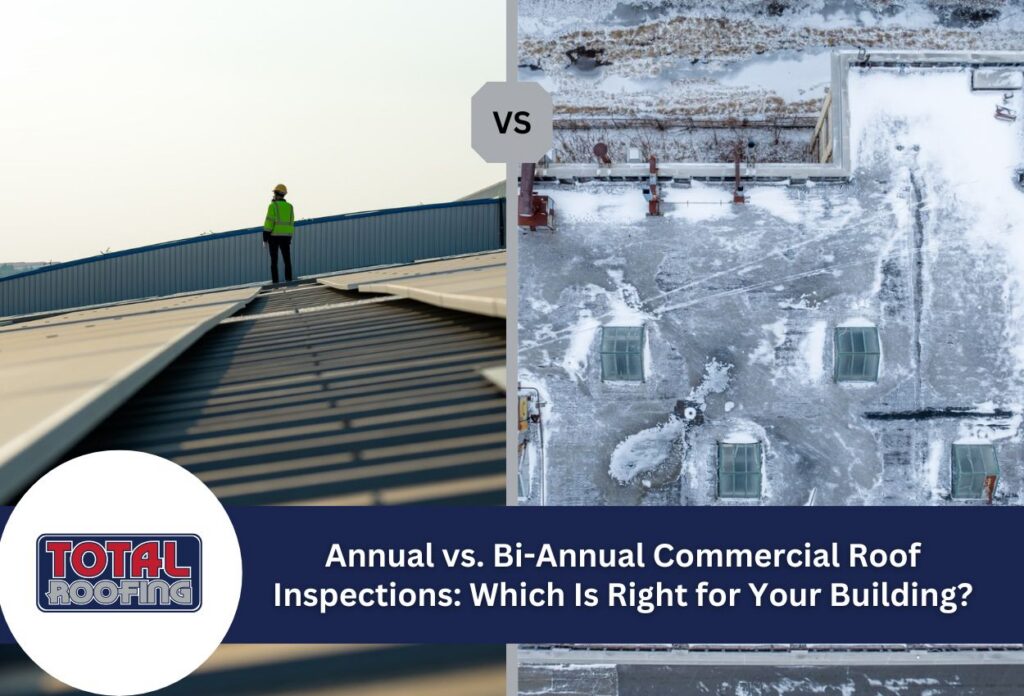

Most St. Louis commercial roofs benefit from bi-annual inspections in spring and fall, though annual inspections may be enough for newer roofs in low-exposure conditions. The region sees 40 to 45 inches of precipitation per year, winter temperatures in the 30s, and summer highs in the mid-80s, plus an active severe-weather season that puts real stress on roofing systems every year.
Industry standards back this up. The NRCA sets twice per year, spring and fall, as the baseline minimum for commercial roofs, with additional inspections after severe weather
*Please note, price ranges listed in this article may not reflect the final cost of your project. Prices are subject to change based on various factors such as local labor rates, material quality, and more. All costs established in this article are rough estimates based on average industry rates.
How Often Should Commercial Roofs Be Inspected and What Do Industry Standards Actually Require?
The NRCA sets one professional inspection per year as the baseline minimum, and most major membrane manufacturers, including TPO, EPDM, and PVC systems, require documented annual inspections to keep warranty coverage active. Many 15- to 20-year manufacturer warranties can be voided by even a single missed inspection year, making the paperwork just as important as the physical check.
In St. Louis, bi-annual inspections are the regional standard. Commercial roofing contractors here typically recommend scheduling in both spring and fall to assess any damage left behind by winter conditions, and fall to get the roof ready before freezing temperatures arrive in November and December. Two inspections per year aligns with the seasonal swings the area experiences, from winter temperatures in the 30s degrees Fahrenheit to summer highs in the mid-80s degrees.
Not all inspections satisfy warranty and insurance documentation requirements; only a professional contractor inspection does. There is a real difference between an owner walk-through and a contractor inspection. An owner walk-through is visual only and creates no formal record. A professional commercial roof inspection includes a full written report, a drainage evaluation, and a seam and flashing check. Insurance carriers and manufacturers require the written documentation that only a professional inspection provides. A quick self-check might catch obvious problems, but it will not protect a warranty or support an insurance claim.
What Does a Commercial Roof Inspection Cost, Annual vs. Twice a Year?
Bi-annual inspections typically add $300 to $600 per year in direct inspection costs compared to an annual schedule, but that gap closes fast when a single deferred repair runs $2,500 to $15,000 or more.
| Cost Dimension | Annual Inspection Schedule | Bi-Annual Inspection Schedule |
|---|---|---|
| Per-inspection fee (flat/low-slope roof under 20,000 sq ft) | $300 to $600 | $300 to $600 per visit |
| Annual program cost | $300 to $600 | $600 to $1,200 |
| Minor repair cost caught early | $200 to $800 | $200 to $800 |
| Deferred repair cost (same issue, caught late) | $2,500 to $15,000+ | $2,500 to $15,000+ (less likely) |
| Estimated 5-year maintenance spend | $4,500 to $10,000+ | $5,500 to $9,000 |
Bi-annual inspections catch drainage blockages, lifted seams, and flashing failures before they cause interior water damage, averaging $5,000 to $25,000 per storm. One avoided leak can cover 3 or more years of added inspection costs. Missouri insurance carriers may also require documented inspection records to process roof-related claims without depreciation penalties, which means inspection costs function as a risk-transfer line item, not just a maintenance expense.
Which Risk Factors Mean Your St. Louis Roof Needs Inspections More Than Once a Year?
Buildings with even one of these risk factors should move from annual to bi-annual inspections, and buildings with three or more may need quarterly checks.
- Roof age over 10 years: Older membranes lose flexibility and become more vulnerable to seam separation and cracking. A roof past the 10-year mark faces added wear from St. Louis temperature swings and should be checked at least twice a year.
- Hail exposure history: St. Louis averages 3 to 5 significant hail days per year. Any storm producing hail at or above 1 inch in diameter should trigger a supplemental inspection, separate from the scheduled bi-annual program.
- Low-slope or flat membrane roofs with internal drainage: These systems depend on functioning drains and scuppers. Even a partial blockage can cause ponding that leads to membrane failure within one season.
- Rooftop HVAC equipment: Each unit creates gaps and flashing details that shift under temperature changes. Multiple rooftop units multiply the number of failure-prone spots on a single roof.
- Known ponding areas: Standing water that remains more than 48 hours after a rainstorm signals a drainage problem that accelerates membrane breakdown and should not wait for a scheduled inspection cycle.
- Prior patch repairs over original membrane: Patches layered over aging membrane create edges and seams that fail faster than factory-installed systems, especially after heat waves above 85 degrees or winter freeze stress.
- Buildings over 15,000 sq ft with multiple drainage zones: Larger footprints with several drain areas require more inspection time and catch more failure points. Annual visits often miss developing issues in secondary drainage zones.
Three observable triggers should prompt an unscheduled inspection regardless of where a building sits in its annual cycle: interior water staining anywhere on ceiling surfaces, visible membrane bubbling or shrinkage after temperatures exceed 85 degrees, and debris accumulation blocking scuppers or drains after any storm. St. Louis’s severe thunderstorm season runs from May through September. Any storm producing 1-inch hail or winds at 60+ mph is grounds for an immediate supplemental inspection, no matter when the last scheduled visit occurred. Our roof storm damage emergency services are available when unexpected severe storms require immediate attention outside of your scheduled inspection cycle.
Annual vs. Bi-Annual Inspections Side by Side: What Each Schedule Actually Covers
Bi-annual inspections catch an average of twice the number of defects per year compared to annual-only schedules, and for membrane roofs approaching the 15-year mark, that difference can extend service life by 3 to 5 years beyond the rated 15 to 20 year lifespan. The table below shows exactly what each schedule delivers across the factors that matter most to building owners.
| Factor | Annual Inspection | Bi-Annual Inspections (Spring & Fall) |
|---|---|---|
| Inspection timing | One visit typically falls | Spring (post-winter assessment) and fall (pre-freeze preparation) |
| Components checked per visit | Seams, drains, flashing, and membrane surface once yearly | Same checks twice a year, covering both seasonal damage cycles |
| Documentation produced | One written report per year | Two written reports per year, a stronger warranty, and an insurance record |
| Warranty compliance | Meets minimum threshold for most manufacturers | Exceeds minimum: supports extended warranty claims and dispute defense |
| Average defects caught per year | Lower one window to identify issues | Higher two detection windows reduce the time the defects go unaddressed |
| Estimated roof lifespan impact | Meets rated lifespan if repairs are not deferred | Extends low-slope membrane service life by 3 to 5 years beyond the rated 15 to 20-year lifespan through early intervention |
A fall-only inspection schedule has one serious gap: it misses a spring assessment of damage left behind by winter temperature changes. St. Louis temperatures cycle above and below freezing an average of 40 to 60 days per year. That repeated movement opens seam separations and flashing cracks that sit undetected and unrepaired through the wet spring season, when 40 to 45 inches of annual precipitation are at their heaviest. For older buildings, pre-2000 construction, or any building with a membrane system approaching the 15-year mark, bi-annual is the minimum recommended commercial roof inspection frequency, not an upgrade. Total Roofing can assess where a building falls on that timeline and recommend the right schedule based on actual roof condition, not a generic calendar.
How Do You Decide Which Inspection Schedule Is Right for Your Building?
Answer 2 or more “yes” questions below, and a bi-annual inspection schedule is recommended for your building. Work through this checklist before locking in any inspection program.
- Is your roof over 10 years old? Membranes past the 10-year mark face added wear and seam flexibility loss. Age alone is one of the strongest signals for moving to inspections being done twice a year.
- Is it a flat or low-slope membrane system? These systems collect water and stress drainage points far more than sloped roofs, making a single annual window too wide a gap to catch developing failures.
- Have you had hail or high winds in the past 12 months? Any storm producing 1-inch hail or winds at 60+ mph can create damage that standard annual timing may miss entirely until interior leaks appear.
- Do you have rooftop equipment or multiple penetrations? Each HVAC unit or pipe gap is a flashing point that shifts under temperature changes. More gaps mean more failure-prone spots per square foot.
- Is your roof under an active manufacturer’s requirement for documented inspections? Most warranties require annual minimum documentation. Skipped inspections result in warranty voidance, undetected minor defects progressing to structural leaks, and insurance claim denials or depreciation reductions averaging 10% to 30% of claim value.
- Has your building had any interior leaks or water staining in the past 3 years? Prior water intrusion is a documented sign of an ongoing vulnerability, not a one-time event.
Annual inspections are appropriate for roofs under 7 years old, with no prior repair history, no known drainage issues, and located on single-story buildings with simple, low-gap profiles. Even then, owner walk-throughs after major storms are strongly advised, but those walk-throughs do not replace a professional inspection or satisfy warranty and insurance documentation requirements. Two or more “yes” answers above mean bi-annual is the right starting point, not an optional upgrade.
What Is the ROI of Adding a Second Annual Inspection to Your Maintenance Plan?
A second annual inspection costs $300 to $600 more per year, and that incremental spend can prevent repair bills ranging from $8,000 to $20,000 when a defect goes undetected through a full season. A minor membrane issue caught early typically runs $400 to $1,200 to fix. Left alone through winter or a full summer heat cycle, that same defect can escalate into membrane replacement or interior damage remediation. That math produces a potential 10:1 to 30:1 return on the cost of one additional inspection visit.
Lifespan data makes the ROI case even stronger. Commercially maintained roofs on bi-annual inspection programs paired with fast minor repairs reach 20 to 25 years of service life on TPO and EPDM systems. Reactively maintained roofs on the same materials typically reach only 13 to 17 years. That difference in service life defers full replacement costs of $8 to $15 per square foot, or $120,000 to $225,000 on a 15,000 sq ft roof, by several years, a far larger figure than the inspection program ever costs.
The cost of annual commercial roof inspection versus twice a year comes down to this: the total annual spend difference is $300 to $600. Against avoided cost exposure in the thousands, that gap is small. Formal commercial roof maintenance agreements with a St. Louis roofing contractor like Total Roofing often bundle bi-annual inspections at a discount compared to scheduling each visit individually, reducing the incremental cost further while keeping documentation consistent for warranty and insurance purposes.
Ready to Set the Right Inspection Schedule for Your St. Louis Commercial Roof?
Skipping a documented inspection before storm season can complicate insurance claims for buildings without a report on file, risk depreciation reductions averaging 10% to 30% of claim value, a direct financial consequence that a single visit can prevent. A baseline inspection report is the starting point for any annual or bi-annual maintenance program, and Total Roofing provides free roof assessments for commercial property owners across the St. Louis area to establish exactly that.
Spring and fall booking windows fill quickly in St. Louis. Scheduling now keeps your building ahead of peak inspection demand and ahead of storm season.
Schedule your free roof assessment
Not ready to schedule? Learn more about commercial roofing inspections and maintenance.