



How Do You Tell If a Commercial Roof Needs Emergency Repair Right Now?
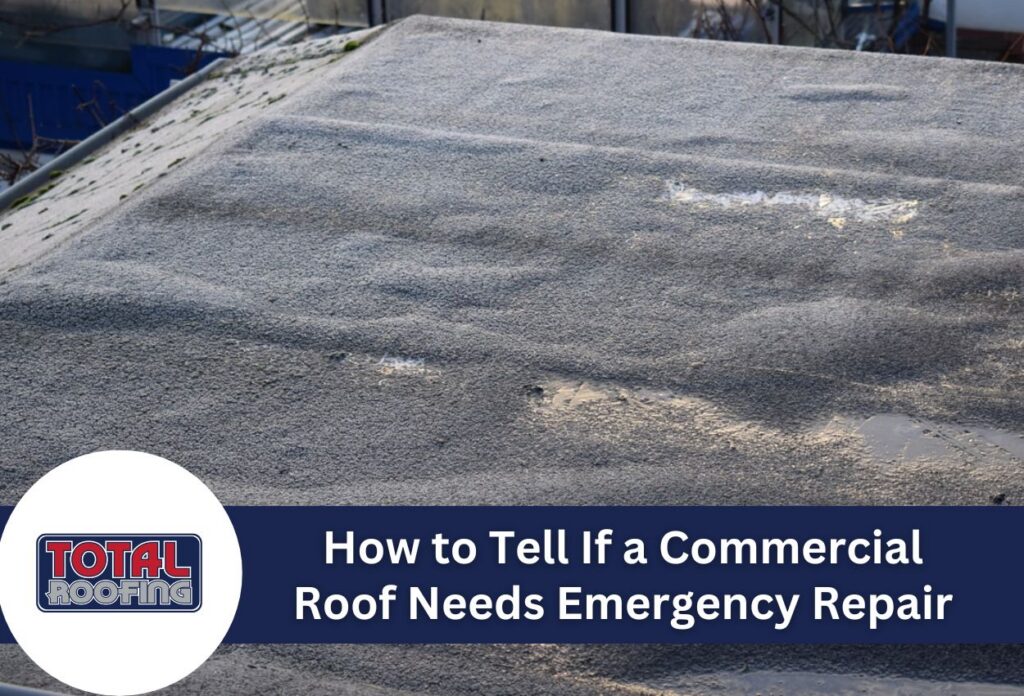

Three conditions define a true emergency: active water entering the building, visible structural bending or sagging, and storm-displaced membrane or flashing. Any of these conditions requires same-day professional response. Damage that falls outside of those specific conditions can typically be scheduled within 5 to 10 days without putting the building or its occupants at serious risk.
St. Louis receives around 34 inches of precipitation annually, and the region sees frequent severe thunderstorms and hailstorms throughout spring and summer. That weather pattern hits flat and low-slope commercial roofs especially hard. Standing water can push through a damaged membrane within hours.
The older buildings common across St. Louis, including warehouses, retail strips, office buildings, and multifamily properties, make fast damage assessment even more important. Many of these roofs already carry years of wear before a storm adds the final stress.
This article gives facility managers and property owners a clear, step-by-step framework for judging urgency, so you know exactly when to call for emergency commercial roof repair after storm damage and when a scheduled inspection will do.
What Are the Most Urgent Signs of Commercial Roof Failure After a Storm?
Active water dripping or streaming inside a building is the most urgent sign of commercial roof failure, and it requires a same-day professional response, not a scheduled appointment.
| Sign | Urgency of Repair | Explanation |
| Active dripping or streaming water indoors | Immediate | Membrane is already breached; call for same-day emergency service |
| Sagging or bending ceiling or roof deck | Immediate | Signals water-saturated insulation or structural stress; vacate the area until assessed |
| Visible membrane splits or wind-lifted edges | 24 Hour | Exposes the roof deck to the next storm; needs assessment within 24 hours |
| Torn or displaced flashing at parapets, drains, or HVAC curbs | 24 Hour | Can allow delayed water entry after storms, especially on older masonry buildings |
| Hail damage indicators on the membrane surface | 24 Hour | Bruising, granule loss, impressions, or dents may hide fractures that worsen under UV |
| Ponding water lasting more than 48 hours after rain | 24 Hour | Indicates drainage issues; standing water adds significant weight to the roof deck |
| Ceiling stains with no active drip | Scheduled | Usually a slow leak; spreading stains escalate to 24-hour urgency |
| Interior mold odor or musty smell | Scheduled | Suggests sustained moisture; schedule inspection to trace the source before mold spreads |
On older St. Louis commercial properties, particularly masonry buildings with aged parapets and flashing details, the absence of an immediate interior leak after a storm does not confirm that the roof is intact. Heavy rain can find a path through damaged transitions and show up as a ceiling stain 24 to 72 hours later.
How Urgent Is a Commercial Roof Repair, and What Happens If You Wait?
A small unaddressed roof leak that costs an average of $500 to $1,500 to repair can escalate into interior damage, insulation replacement, and mold remediation costing $10,000 to $75,000 or more if ignored for 30 to 90 days. Deciding when to act is a financial decision, not just a safety one. Every situation falls into one of three urgency tiers:
- Emergency: Structural bending, active leaks near electrical panels, or water threatening inventory require a same-day response. Waiting even a few hours in these situations can create liability, safety hazards, and damage that multiplies repair costs far beyond the original issue.
- Urgent: Post-storm membrane damage, blocked or overflowing drains, and lifted flashing at parapets or HVAC curbs all fall here and should be repaired within 24 to 72 hours. These conditions move into the emergency tier as soon as water entry begins or ponding lasts for more than 48 hours.
- Monitored: Minor blistering, surface cracks, and ceiling staining without active moisture can be scheduled for a repair within two weeks. A monitored situation becomes urgent the moment staining spreads, odor develops, or a new storm is forecast.
Insurance timing adds another layer of urgency. Most commercial property insurers recommend storm damage be reported and temporarily resolved within 24 to 72 hours of the storm to preserve claim eligibility. Delaying documentation, even by a day or two, can cost a property owner the right to file a valid claim entirely.
What Should a Commercial Roof Damage Assessment Cover?
A complete commercial roof damage assessment covers two distinct areas: an interior inspection for signs of moisture entry and an exterior inspection of the membrane, flashing, and drainage system. Documenting both areas with dated photos and timestamps supports both contractor diagnosis and insurance claim submission, and skipping either half leaves gaps that can cost a property owner coverage or delay repairs. All exterior roof access should be attempted only by trained roofing professionals, never building staff or property owners.
Interior Check
- Ceiling staining or water rings: Mark the location and photograph with a timestamp. Stains that spread between checks confirm an active slow leak.
- Active drips or pooling water: Note the exact location of dripping or pooling water; any dripping near electrical panels or HVAC units moves the situation to the emergency tier immediately.
- Bubbling or peeling paint on ceilings or upper walls: Indicates moisture trapped beneath the surface, often from a slow or intermittent leak.
- Musty or moldy odor: Signals sustained moisture over at least several days; requires moisture tracing before the next storm.
- Visible roof deck bending or ceiling sag: Any downward bending or sagging, even minor, points to water-saturated insulation or structural stress. Vacate the area below.
- Moisture near electrical conduit or HVAC equipment: Escalates urgency to a same-day response, regardless of whether interior dripping is present.
Exterior Check
- Membrane surface condition: Look for splitting, surface cracking, blistering, or granule loss.
- Flashing at transitions and parapets: Check for separation, lifting, or rust at every pipe boot, curb, and wall-to-roof transition.
- Drain and scupper status: Confirm that all drains and scuppers are clear; ponding water lasting more than 48 hours after rain adds roughly 5 pounds per square foot of weight to the roof deck.
- Ponding zones: Photograph standing water with timestamps showing duration.
- Seam strength: Check laps and seams for open edges, voids, or separation.
Common Failure Points by Roof Type
| Roof Type | Common Failure Points | What to Look For |
|---|---|---|
| EPDM | Seams and field membrane | Seam separation, punctures, shrinkage pulls at edges |
| TPO | Heat-welded seams | Weld failure, membrane shrinkage, open lap edges |
| Modified Bitumen | Surface and laps | Granule loss, surface cracking, lap separation |
| Built-Up | Surface plies and blisters | Deep cracking, blister rupture, gravel displacement |
Once both interior and exterior checks are complete, organize every photo with a date, time, and location note before sharing with a roofing contractor or insurance adjuster. This documentation is what turns a general damage report into a defensible claim record.
When Should You Call an Emergency Commercial Roofer vs. Wait for a Scheduled Inspection?
Knowing when to call an emergency commercial roofer comes down to one question: is water actively entering the building right now? In the St. Louis market, emergency roof repair services typically respond within 2 to 6 hours for active leaks, compared to 24 to 48 hours for urgent-but-stable situations. Temporary emergency tarping or sealant application, which typically costs $300 to $800 for a standard commercial section, is the standard first response to stop water leaks while permanent repairs are being planned. This cost is often reimbursable under commercial property insurance policies.
| Scenario | Call Emergency Commercial Roofer Now | Schedule Within 5 to 10 Business Days |
|---|---|---|
| Interior leak | Active drip or stream present | Old stain, no current moisture confirmed |
| Ponding water | Standing water over 1 inch, 48+ hours post-storm | Surface moisture dried within 24 hours |
| Ceiling or roof deck condition | Visible sag or bending of 1 inch or more | Soft or spongy membrane, no interior signs yet |
| Electrical or HVAC proximity | Moisture within 3 feet of panels or equipment | No electrical exposure, moisture is isolated |
| Membrane or flashing damage | Torn membrane or displaced flashing after a storm | Minor surface cracking or blistering, no open gaps |
| Odor or air quality | Mold visible or strong odor near active wet area | Faint musty smell, no visible moisture or staining |
Most scenarios in the left column involve water that is moving, accumulating, or threatening building systems right now, and those situations should never wait. When done within hours, an emergency roof tarping or sealant application costing $300 to $800 can protect the roof deck, insulation, and interior finishes from water damage, preventing repair bills from escalating into the tens of thousands of dollars. If a situation falls in the right column, document it with dated photos and reassess after the next storm, as conditions can shift urgency levels quickly.
What Does Emergency Commercial Roof Repair Cost, and What Is the ROI of Acting Quickly?
Emergency commercial roof repair costs range from $300 for temporary tarping to $75,000 or more for full interior remediation, and the difference between those numbers is almost entirely determined by how fast the first response happens. The following comparison compares the standard pricing for each type of response alongside the expenses it prevents.
| Intervention Type | Typical Cost | Avoided Cost (If Done First) |
|---|---|---|
| Emergency tarping or temporary repair | $300 to $800 | Avoids $800 to $3,500+ in membrane patch costs if water spreads |
| Emergency flashing or membrane patch repair | $800 to $3,500 | Avoids $8,000 to $25,000 partial section replacement |
| Partial roof section replacement after delayed repair | $8,000 to $25,000 | Avoids $10,000 to $75,000+ full interior remediation |
| Full interior remediation; mold, insulation, and ceiling replacement | $10,000 to $75,000+ | No recovery option; this is the cost of waiting too long |
Even though same-day emergency calls can bring premium labor rates up to double standard billing, the cost is typically lower than the expense of a single week of untreated water leaks damaging inventory, equipment, or interior finishes. Roofs that receive fast repair after a storm and bi-annual commercial roof inspections have a much better chance of reaching their full rated service life: 20 to 25 years for EPDM, 15 to 20 years for TPO, 15 to 20 years for modified bitumen, and 20 to 30 years for built-up roofs. Neglected roofs in high-humidity climates commonly fail 5 to 10 years early, turning a maintenance cost into a full replacement years ahead of schedule.
Ready to Find Out If Your Commercial Roof Needs Emergency Repair in St. Louis?
Total Roofing serves the St. Louis area with emergency commercial roof assessments for active leaks, storm damage, and urgent structural concerns.
Each initial inquiry provides an expert commercial roof damage evaluation. This gives building owners a transparent, well-documented overview of current issues and the necessary corrective measures. When it comes to emergency commercial roof services in the St. Louis region, acting quickly is important. The difference between a simple patch and an extensive repair depends directly on how fast you contact a professional for assistance.
Not ready to schedule? Learn more about commercial roof repairs.